

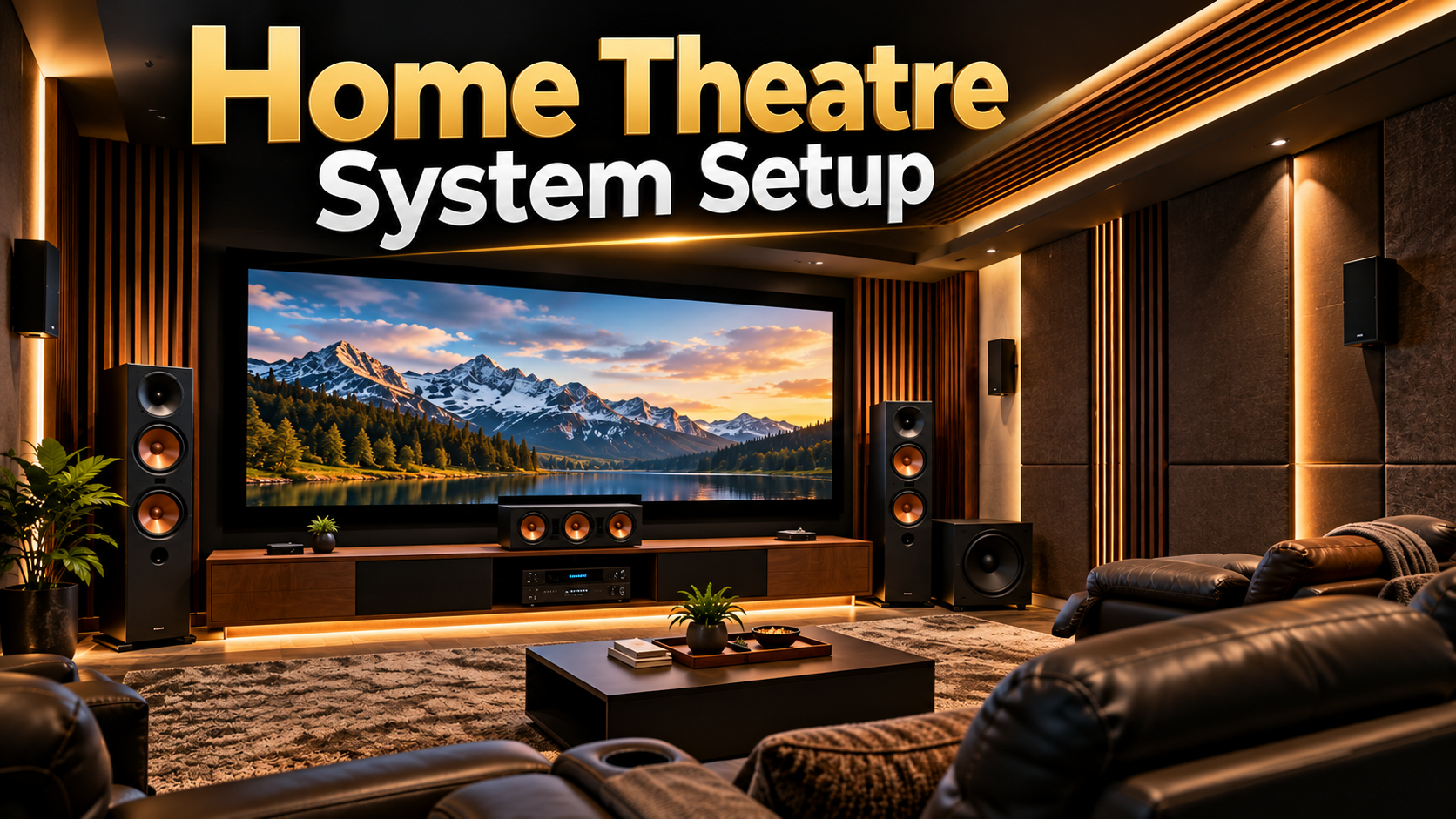
A good movie experience is not just about a large television or a 4K projector. Good dialogue, decent bass, surrounds, and speakers are properly placed and better surround sound will come together to give you a good home entertainment experience. A perfect Home Theatre System Setup will create the magic of watching movies, sports, music, and so on with a better surround sound experience at home.
Each room will have a unique blend of sound and different arrangement of furniture and lights to how you use your gear and where you sit in the room may result in some seriously lousy sound. An appropriate choice of gear and setup can produce the desired output and allow you to absorb a much more natural sound.Home Theatre System Setup guides home owners on a range of home theater solutions aligned to their entertainment requirements and space availability. Arranged with appropriate planning, equipment selection and system installation, homeowners get a cozy entertainment zone with a more pleasurable movie watching experience.
Understanding the Importance of Home Theatre Audio
The quality of Home Theatre System Setup, such as sound effects, music, foreground noise and on-screen dialogue greatly affects the experience audiences have while viewing films and other entertainment. When dialogue is difficult to decipher or sound effects are not as powerful as they should be, this could be the result of poor speaker placement or improper system set up.
A well thought out Home Theatre System Setup maintains proper balance between the parts of your system and the room placement of the speakers and receiver. When all work in harmony you will notice a finer clarity of sound reaching your listening space.
Listed below are the main advantages:
Easy conversations:
Correct speaker placement allows for simple conversations.
Around the room surround sound:
Several speakers can be used to deliver a more natural location and motion.
A well placed subwoofer deepens, but doesn’t overpower.
Enhanced Music playback:
Music listening pleasure through audio equipment.
In an orderly room, viewers can have extended movies viewing comfortably.
These enhancements can make having a home entertainment area more functional and fun for a variety of programming.
Essential Components for Better Sound Quality
Every piece of hardware in a Home Theatre System Setup is there to do something. Ensuring you have compatible equipment can help to make sure the entire system works as it should.
1. Speakers for Clear and Balanced Audio
The speakers produced dialogue, music and effects The content and number of Home Theatre System Setup and their positions will affect what the listening experience will be. The front speakers would usually provide the majority of music and dialogue, with the surrounds providing the effects and ambient effects.The distance between the speakers should be as above for the room size, your seating position and the kind of listening experience you want.
2. AV Receiver for Audio Management
The audio-video receiver is used to link up the compatible entertainment devices and project the music to the Home Theatre System Setup. The television, projector or gaming console and the current systems of sound may be compatible with various surround sound processors, auto speaker setup and different inputs depending on the receiver model. Choosing a receiver that is suitable for the type of speakers and the configuration ensures consistent operation.
3. Subwoofer for Deeper Bass
The subwoofer offers the reproduction of all bass sounds (bass notes in music and effects in movies). It can help make your favorite action or dramatic film better, and your Home Theatre System Setup more powerful – but if you put the subwoofer in the wrong place, the result could be more bass than you wanted, or bass that is uneven from one side of the room to the other.
4. Display and Source Devices
The visual display is delivered by a television or projector The content comes from source devices including: such as a streaming device, a Blu-ray player, or a gaming system.
While the quality of the display does not have a direct impact on the audio aspect, ensuring it has the right fit with the sound system will enable viewers to enjoy well-synchronized audio and video with reduced connection issues.
How to Plan a Home Theatre System Setup
It all starts with creating a good room, instead of starting by buying gear. There’s a good reason to have a plan, and it can help you steer clear of pitfalls and maximize your budget.
Assess the Room and Available Space
Measure the room, identify the location of doors, windows, furniture and electrical points. These will all determine the locations of Home Theatre System Setup and the routes for wiring.
Hard floors, windows and bare walls can lead to unwanted reflection, but rugs, curtains and a degree of acoustic treatment can be used effectively to counteract this.
Select the Right Speaker Configuration
Various configurations can support different listening needs. A relatively small room will do the job fine with a simple setup, while a dedicated entertainment room can handle some extra surround or height Home Theatre System Setup.The selection must take into account size of room, processing capabilities of the receiver, seating plan, and your preferences. Expansion will not necessarily result in better quality of sound; however, location and tuning are essential.
Position Speakers Correctly
The front speakers should be balanced at the front of the display with left and right Home Theatre System Setup on either side of the screen. When the centre speaker is used it should be placed below the display close to the screen for improved dialog placement. Rear surround speakers will be placed in the supported format and room configuration.The primary seating position makes a difference as well. Some systems may have a certain sound when people sit directly in front of the speakers, for example, but a different sound when they sit to the side.
Organize Cables and Connections
Home Theatre System Setup cables can be tidily arranged and less clutter is created, making equipment easier to access and maintain. Use the correct cables/connectors for your equipment, secure loose wiring and ensure ventilation areas are clear.Pre-wire cable routes so that wiring is not visible once installed which may otherwise impact on the visual effect of the room. Power connections should be pre-wired in a safe manner according to equipment instructions and electrical needs.
Calibrate and Test the System
With everything in place, set the distances and levels of the speakers, crossover configurations and any room-correction options available. Although default calibration can be a helpful guide, you can try changing levels during listening tests to further enhance the end result.Try out the Home Theatre System Setup on movies that are rich in speech, have music, and use many special effects with positional sound. Doing so will make it quite obvious if a speaker has been set either too high or low or incorrectly positioned.
Comparison of Home Theatre Configurations
The right arrangement depends on the room, equipment, and entertainment goals. The following table outlines common options.
| Configuration | Main Components | Suitable For |
| 2.1 channel | Two speakers and one subwoofer | Compact rooms and everyday entertainment |
| 3.1 channel | Three front speakers and one subwoofer | Clear dialogue with stronger front sound |
| 5.1 channel | Five main speakers and one subwoofer | Traditional surround sound experiences |
| 7.1 channel | Seven main speakers and one subwoofer | Larger rooms with additional surround coverage |
| Dolby Atmos configuration | Compatible speakers and height-channel support | Three-dimensional audio experiences |
These configurations are general examples, not universal recommendations. Actual requirements vary according to room dimensions, equipment compatibility, speaker placement, and supported audio formats.
Creating a Comfortable and Practical Entertainment Space
Nice quality Home Theatre System Setup, but comfort and accessibility is important. Location The speakers need to be set up somewhere that you can see the screen, but not too far away to be heard through the speakers. The room should allow enough room for you to walk around comfortably.
Position lighting as required for movie, game, or play. Equipment racks should be well ventilated with controls accessible at the time of maximum use.
Seating arrangement may be all that is needed to keep speakers from being hidden behind a sofa, cabinet, or objet d’art.It is necessary for any Home Theatre System Setup to be flexible as it will have to cater for those unexpected days but also those planned movie nights. Owners could be considering future upgrades such as some additional well balanced speakers, enhanced soundproofing or even extra entertainment devices.
Professional Installation
Nice quality sound, but comfort and accessibility is important. The Home Theatre System Setup needs to be set up somewhere that you can see the screen, but not too far away to be heard through the speakers. The room should allow enough room for you to walk around comfortably.
Position lighting as required for movie, game, or play. Equipment racks should be well ventilated with controls accessible at the time of maximum use. Seating arrangement may be all that is needed to keep speakers from being hidden behind a sofa, cabinet, or objet d’art.
It is necessary for any Home Theatre System Setup to be flexible as it will have to cater for those unexpected days but also those planned movie nights. Owners could be considering future upgrades such as some additional well balanced speakers, enhanced soundproofing or even extra entertainment devices.
Conclusion
It’s much more than just a plug-and-play system. There are numerous other factors that influence the final result including the placement of your speakers, the matching of the receiver, the acoustics of the Home Theatre System Setup, calibration, design of the subwoofers etc. Get all those factors right, and you will feel like you’re right there in the action.
A well-designed Home Theatre System Setup would be scalable to the dimensions of your room, the type of viewing desired and the capability of the equipment. Selecting the right equipment and positioning it correctly can be just as important as upgrading the number of speakers or investing in more costly equipment.
Soundville Studio to assist homeowners to find the best home theatre that suits their space and entertainment needs. With proper planning, the right set of home theatre equipment, and a focus on sound quality, you can truly make your home a favorite place to stay for the rest of your life.
Frequently Asked Questions (FAQs)
1. What is a Home Theatre System Setup?
It is the procedure of choosing, connecting, installing and adapting any systems such as sound and picture equipment used in a pleasurable home cinema.
2. Which speaker configuration is suitable for a home theatre?
2.1 channel setup might work for a small room. But a 5.1 channel surround sound system is a more typical solution. The ideal set up will be influenced by room size, quality of equipment and financial limits.
3. How does speaker placement affect sound quality?
The placement of the speakers affects the clarity of the dialogue, direction of the sound, balance of the listening area and also the overall surround sound effect. Proper placement aids in the sound reaching the main listening area.
4. What subwoofer is necessary for a home theatre?
Not every Home Theatre System Setup needs a subwoofer, but it does offer better bass extension and more impact from movie effects and music. That said, it should be determined based on the speakers, the room, and how you like to listen.
5. Can a home theatre be installed in a small room?
Yes. For a small room, a proper home theatre system can be installed provided the size of the equipment, the distance from the seating position, placement of speakers and cable routing are managed properly.
6. Why is calibration important after installation?
Calibration balances speakers, adjusts distances, and sets the available audio parameters. This can add consistency and make talk, music, and effects easier to enjoy.